Showing posts with label ET. Show all posts

Sunday, June 30, 2024

Worlds of the System

    There are dozens of intelligent species in the System, but only a handful have a significant presence in interplanetary space. Producing spaceships requires the kind of highly-developed orbital heavy industry that few planets possess. 

    (Most) spaceships are moved by chemical rockets which operate by destabilizing metastable metallic hydrogen. This metallic hydrogen is harvested from suspended clouds of particulate in the atmospheres of Eos and Phaethon, two of the System's gas giants. The "mining" procedure is very safe, in modern times, and can be performed almost entirely by unmanned aerostats. Collecting the fuel is what's dangerous — piracy abounds, and an oxygen leak in the fuel-rich atmospheres of the gas giants will result in terrifying firestorms visible from orbit.

    Control over fuel production is control over the System. This has been conclusively demonstrated in the fifteen years since the end of the Second Battery War. At the beginning of the hostilities, Lith and her allies — the Sylvans of Satanazes, the mercenary armies of Koss, the theocrats of Pure and an engineering corps of callow Avian idealists — were opposed by fleets of pirates, rebels, adventurers, mafias, industrial magnates, technological adepts, factions in their own parliament, and the obscure influence of Phobos. The suggestion that fuel production might be entirely annexed and nationalized by one planet inspired strange alliances. Civil conflict erupted even on planets not officially engaged in the Battery War; Lith's brutality in seizing or destroying all foreign stores of fuel, even those in civilian hands, was matched only by their enemies' determination to recover it first. For a time, interplanetary trade was disrupted by the fact that no cargo could be as valuable as the engine that moved it. The capital of Lith was blockaded for two years and its space elevators were sabotaged. Holy sites across Pure were destroyed, some by orbital strikes, others by suicide attacks. Hundreds of stations throughout the System were bombarded by either or both sides. Millions were killed.
    But the Second Battery War could only ever have one outcome. Early supply issues led inexorably to later military catastrophes, and when Lith succeeded in monopolizing production, those who had opposed them found the gates of heaven closed and barred. Fuel is monitored now, and its disbursement tracked. Of course, some slips are still made, despite all of Lith's precautions — piracy abounds, after all, and a small-time operator may grow desperate enough to sell her scrip to a friend with dire need and deep pockets. But the era of the Free System is over. There are no fleets left to check Lith's ambitions. Opposition to the hegemony, where it exists, now takes subtler forms.


Sizes are illustrative; the planets are depicted ~two orders of magnitude larger as a visual aid.

Ava

    Ava is a gas dwarf with a rocky surface. Its atmosphere is dense, foggy and cold, but full of volatiles the Avians synthesized into the first rocket fuels. In prehistoric times the members of the Avian species fought for access to higher nests farther up the rocky mesas and pillars which make up the landscape, where their eggs would be protected from shuffling ground-based predators. It's a common evo-psych Just So Story that this behavior is what drove them ever higher, building homes and towers, and eventually ships to take them as high as anyone can go; interplanetary space.
    Avians follow a strict caste system. All Avians are hexapods; those whose third pair of appendages are feathered wings are Scholars, those with bat-like wings are Soldiers, and those with monstrous oversized hands are Servitors (nowadays called Workers due to a social-justice fad sweeping Ava). These traits don't breed true; Scholars have an equal chance of having children who are soldiers or workers. Because of this, Avians do not form biological family units. All Avians are raised by the state.
    Scholar-caste Avians are the largest and (according to the majority opinion of Avian scientists) the smartest. They occupy choice spots in the bureaucracy of Avian governments, and are the most visible caste off of their homeworld. They like to say they have the temperaments of "ambassadors" and "architects", but more accurately they are "meddlers" and "enablers"
    Soldier-caste Avians are the smallest, and since Avians are the smallest space-faring species this makes the soldiers very small indeed. They often serve as pilots of small craft and are by far the most numerous caste off of their homeworld.
    Worker-caste Avians are the strongest, though not as gifted at war or politics as the others. There are just as many workers as any other caste (or more, considering the mortality rates of fighter pilots) but since they rarely leave Ava you wouldn't guess.

Engineers

    On the topic of "meddlers" and "enablers": when Avians first invented interplanetary travel, they visited every world with a species that could talk and made a simple offer: give them half of the money on the planet, and they will build a space elevator. This led to the First Battery War almost immediately.
    But still, almost every captain in the System has at least one Avian officer. Their intuitive understanding of the dynamics of space travel and the mechanics of a ship's engine make them invaluable additions to a crew.

Purity

    Purity is a young and volcanically active terrestrial planet controlled by a theocratic world-government. There's a stark divide between the city-dwellers who submit to the theocracy (and by extension Lith), the wastelanders who are one step from being completely feral, and the space pirates who acknowledge no authority except their god and their guns. The Pure are a little insectile and a little reptilian, with high population variance in types-and-placement-of-limbs. Some have spider legs, some have additional arms, some have bat wings, some have clawed pedipalps.
    Their god, Pure, is the six-armed guardian of the Gates of Death and judge of mortal souls. In one hand he holds a toothy spear and in another a barbed lash, in a third the keys to Hell, in a fourth a lantern whose light reveals honest men, in a fifth the great and heavy book where your sins are recorded, and with a sixth he turns its pages of smoking brass. Fond of fighter-pilots and infantry. Hates snipers and landlords. Pilots of all species wear his symbols as lucky charms.

Lucky Charms

    Lith's state religion is the Communion of Measure, or the Compassers, depending on your translation. They have accepted and absorbed the gods of other worlds, though they renamed them after their planets in the process. The gods obviously favor Lith over their own people, and a wise businessman never misses an opportunity to capitalize on a positive relationship.
    Non-Lithians are not as eager to adopt the mores and tenets of other cultures. The one general exception to this rule is the god Pure. All spacers are afraid of "dying cold" — to run out of food, out of air, to be pinned under rubble or impaled on flotsam and die of thirst, to bleed out slowly, or (the unnameable terror) to float off into the dark with no tether, no radio, no jets, in a suit topped up with oxygen, and nothing at hand sharp enough to cut your tubes, or sturdy enough to break your faceplate. Superstitious spacers wear Pure's octagram and hope it guarantees them a hot death.

Satanazes

    Satanazes is an unmapped and untamed world. Woses, the males of the dominant species, are obligate carnivores, in that they are obligated to eat animals: when they see an animal, they eat it, even if that animal says "wait please I'm an ambassador I just want to talk please aah". The only creatures that Woses don't immediately reflexively attack are the Sylvans, the females of their species. When circumstances demand that they communicate with others, they do so through the intermediary of their many wives. When circumstances demand that they communicate in person, they show up wearing Scary Attack Dog gear with sturdy chains their wives hold like zeppelin anchors (picture a conversation with a bus-sized tiger that tries to jump on you every few words, held back by half a dozen catgirls). Lithians occasionally try to Weyland-Yutani an adolescent for scientific study, an endeavor with a 100% catastrophe rate.
    As for the Sylvans, at birth there are roughly three of them for every Wose, but as the males grow to adulthood, establish territories, and fight each other for status that ratio increases to more than 10:1. The Woses simply can't keep up with the demand, and so many Sylvans seek both employment and romance off-planet. Many Lithians have problematic attitudes about them.

Painted Tongue

    The Sylvans have a complex tradition of body modification and decoration, which in these days of interplanetary travel has both spread to and been influenced by the other worlds of the System. Piercings, especially facial piercings, are unsuited for spacesuits and breathing tubes, so many Sylvans have brightly-colored but meaningless tattoos splitting their lips or brows, or across the alars of their nose. They think little of clipping their own ears to better fit their helmets — Sylvans heal rapidly, even from serious disfigurements.
    Those who wish to be genuinely outre (which is most Sylvans) must go to more drastic lengths: false teeth of gold or surgical steel or black ceramic, auxiliary lenses, needles of magnetized neodyme in the fingertips, carbon filament knitting sheathing the ribs. A symbolically important modification, rarely imitated by other species, is what Sylvans call umineko: to gnaw off the tip of one's own trigger finger, declawing it, and making it possible for them to handle guns designed for other species.

Koss

    The Koss homeworld is a freezing ocean planet. They were a happy, peaceful people once; tubby walrus-frogs well-suited for their place in the ecosystem, content to swim and sing and live off of kelp and anchovies for a million years more. When the Lithians noticed how big and brawny they were, and beamed them up, and taught them how to make war, the Koss discovered that they were good at fighting. They enjoy it so much that the majority of Koss adults off-world are employed as shock troopers and policewomen to this day.

Contracts

    One half of a Koss contract slightly resembles a vacuum tube, though the low-density nacreous boron ceramic (LNB) shell is much more durable than glass or wire. Mated, the two halves reveal fine-detail legalisms, which typically begin with the religious formula "It appears that she who bears the one part of me owes five years" (or whatever length) "of armed service to whosoever bears my other part, howsoever it be obtained". The Koss regard these trinkets with fatal seriousness. Treasure-troves of legend often include the "rash boon", a contract of indefinite length promising the bearer arbitrary service from a hero, though this practice is not historically attested. 

Lith

    Lith is a desert planet very close to a powerful star. The biosphere is limited, and irritable. Lithians themselves are horned and bat-faced humanoids with long gangly arms and stubby powerful legs. Their skin is slightly-luminescent lavender in the visual range, and mirror-bright in higher EM bands. None of this is important information; what matters is that they won the Second Battery War, and the System is theirs.

Megastructures

    Lith's enormous industrial capacity is sometimes tapped to support grand Parliamentary hazards. Some are moderately successful, though rarely to the degree promised, and never enough to justify the enormous cost in blood, treasure, and the time of engineers.

  • Emitter Bloc
        A swarm of power-collecting nodes orbits the sun closely; each of these sends a beam of directed energy up to the swarm of control nodes which orbit the sun at a distance; these in turn direct powerful masers and lasers towards innumerable reflectors, retransmitters, beam expanders, radio arrays, and both manned and unmanned deepwater installations. The Lithians use the Bloc to secure and obscure communication. Recently (or not so recently — secret projects are hard for outsiders to keep track of) they have even begun using it as a form of propulsion for stealth probes, which can be precisely maneuvered by limited bursts of energy caught in retractable sails. If you had the correct access codes, and a compatible sail, you could use this system to travel anywhere in the System you wanted, at impossible speeds, using no fuel, while remaining no more conspicuous than any piece of lifeless space-junk.
        The notion that the Bloc could be used to destroy a planet is, of course, absurd. The energy requirements, the wear and tear on components, the fact that the planet-destroying beam would have to be bounced off of a series of large mirrors — impossible. But you should still try to avoid driving your ship into one of those emissions.
  • Mechanical Intelligence
        Sailors tell tall-tales of machine-minds going insane and turning against their masters. The engineers who build the devices know this is a fundamental misunderstanding. A "mechanical brain" is nothing like a brain; it has no volition and no agency. It is a clockwork device to calculate orbital trajectories, intersection ranges, and other matters which would be slow and imprecise for a (non-Avian) pilot to calculate by hand. It can only turn against its masters in the way of all machines: by failing, like a jammed gun or a leaking oxygen tube.
        Still, Parliament dreams of a machine-mind that can not only calculate but decide what must be calculated. Then the grim-faced Avian engineers would be made obsolete. Perhaps Lith would be able to exploit Ava's greatest secret: the Sewing Drive, which allowed Avian freedom-fighters of the Second Battery War to cross the System faster than the radio waves that warned of their approach.
        The engineers, for their part, have never provided such a machine.
  • Company Loyalty
        The B.S.L. Hand That Feeds is a research vessel in orbit around one of Satanazes' dead moons. Two years ago they began experimenting with a new non-invasive transcranial magnetic procedure on their stock of Woses. Their first few attempts led only to aneurysms, partial lobotomies and fatal grand mals, but yesterday they had a breakthrough: if a certain portion of the amygdala can be targeted and electronically destroyed, the Wose loses its hostility to non-Sylvan life. There appear to be no other side-effects of the procedure.
        The lab crew are now split, evenly, on the question of what they should do with this knowledge. But how can there be an argument against applying it to the entire male population of Satanazes? The primary cause of mortality among Woses is death at the hands of another Wose. Surely, say one half of the team, this treatment is as ethically straightforward as a cure for cancer — or for suicidal impulses, if you prefer. There's no moral value to being brutally murdered by an apex predator, no matter how romanticized or "natural" your life might have been.


Phobos

    Phobans [or Phoebans, my notes disagree] come from Phobos [or Phoebe, ditto], a debris field orbiting the dead twin of the System's sun at an extraordinarily far distance. Their homeworld's star was stillborn, deprived of essential stellar material at birth and ripped apart in the formation of the System
    The Phobans are used to darkness, crushing gravity-shocks, and the near-silence of trace atmosphere. When they visit other worlds they wear protective, concealing garments, and speak very little through the medium of crackling radio.
    They have hated the Lithians since they met them. Phobos is the sole polity of the System which never officially agreed to the armistice which ended the First Battery War, though hostilities ended generations ago. It takes months or years to reach Phobos by rocket, and dozens of hours to contact it by radio.

Graffiti

    A spaceman who visits enough far-flung stations will see symbols repeated in unlikely places. Even in the high, high wilderness, out past Phaethon, you'll see the tags, badges and seals of the same distant gangs, regiments and academies painted on the walls or chipped into the paint.
    One motif is the "midnight sun", a yellow disc on a black field. For those who can put aside the victories and defeats, the profit and the loss, it symbolizes the freedom Lith promises: freedom from oppression, freedom from want, freedom of self-expression — nothing like the freedom of the Free System. It might appear in a rewinding station to mark the speakeasies of the counter-revolutionaries, or on a mining base to show the way to a supply cache, or it might be found on a distant asteroid, a hundred million miles from Lith, over a mass grave.
    For their part, the Phobans hate the symbol (and for this reason it's sometimes used as nothing more than an expression of anti-Phobos sentiments). They have no fondness for the Sun. It's no brighter than any other stellar object in their homeworld's sky, certainly not bright enough to dispel the permanent gloom, or disperse the clouds of carbon dust which shield the surface from the hateful stars.

Tuesday, March 14, 2023

Spaceships of the System

     Inspired by friend-of-the-blog Archon's excellent work on Orbiters Local 519 (print copy here), and recently reminded of this project by Skerples' sci-fi thoughts, I've been reworking a very old setting of mine. It's a sci-fi sword-and-planet sort of thing, leaning towards the oiled-up-barbarian side of the He-ManBlindsight axis and standing with Kirk in the middle of the John CarterTNG axis.


    Hey! Author here: I was so amused by the idea of the chart I described in the paragraph above that I spent two hours assembling it and arguing about it on Discord. Here it is. If you disagree, leave an angry comment and I might update the chart/insult you.

I don't like the terms "hard sci-fi" and "soft sci-fi", I find them imprecise and obfuscating, for reasons I shan't repeat in this caption but will gladly elucidate if you buy me a beer.


    But how do you go about explaining a setting? Off the top of my head, I can't think of any tabletop "setting guide" I really enjoyed or found interesting, especially not before playing the damn game. Information I must choke down is never satisfying. So instead of a big timeline and a long list of events, I'll be cutting the "guide" into some big chunks of (maybe) useful player information.

    The System is, obviously, a solar system. It's made up of dozens of life-bearing planets, with almost as many intelligent species, orbiting a subgiant star named, unimaginatively, "the Sun". The System's civilizations have been spacefaring for a few centuries, but tech level is still well below that of Star Wars — it's a bit like the Honor Harrington books, if you've read those. No glowing energy shields, no talkative robots, no demigod AI, no traveling to other solar systems, combat largely centered on torpedo salvos (love a salvo) and railgun broadsides (love a broadside) and boarding actions (love a good boarding action). If you want to matter in the System, you've got to get a ship.


Assumptions:

  1. Spaceship Boats. Spaceships aren't fragile collections of exchangeable modules (like modern spacecraft and the ISS), they are big boats. They're built once as a big solid hull with a front end and a back end, and then they're basically the same thing forever. A spaceship might pass between many captains over decades and decades of service, until it meets with catastrophe or the maintenance costs grow too high, and then it's scrapped. You know, like a boat.
  2. Space Submarines. Spaceships are specifically like the kinds of boats that go around under the sea, sometimes called unterseeboots. Most of them are cramped, overbuilt pressure chambers where the expected fail-state is "irretrievably lost with all hands".
  3. Cassette Futurism. Spaceships are driven around by pilots with minimal artificial assistance, mostly from analog instruments. Space stations are run by people, not AI. Most problems can be solved with a wrench and a slide rule. There are no touchscreens.
  4. Artificial Gravity. It exists in a lot of sci-fi, but I feel like pointing it out.
  5. Fuel is Valuable. Most spaceships run on chemical rockets, which need fuel to operate. Control of that fuel is control of space. 
  6. Interplanetary Travel is Slow. Transit times are long. Even with spaceships several times faster than our earth-rockets, traveling to a different world will take you weeks or months. 
  7. Interplanetary Space is Big. This is a corollary to the last point. The harder it is to move around, the harder it is to find someone or chase down a lead or explore an unsettled world, and the easier it is to hide yourself or get lost forever.

    While I've got you, I should mention that a "ship" has the fuel and life support capacity to travel between planets, while a "boat" does not. Carry on.


Terminology:


     Any numbers given for crew-count assume a military vessel. The complement on civilian ships is typically less than a quarter of that of military ship of comparable size, because they don't expect major repairs, long duties at battle-stations, boarding actions or the need for replacements. Pirate ships are usually stuffed to the gills (often twice the complement or more) for all the opposite reasons.
  1. Destroyer 
    A destroyer is any warship (i.e. a ship for fighting ships) which is shorter than 100m. Usually crewed by fewer than 300, without a complement of boarders. Doesn't carry its own depot (material for maintaining the ship and crew) so needs a tender. Any pirate would be proud to fly a real destroyer as his flagship, while planetary governments have dozens of them and the Lithians have so many they use them for policing.
  2. Cruiser
    100m to 300m, 300 to 800 enlisted. Ships of this size usually have a complement of borders, and this is the the sweet spot for a large ship to carry its own depot. Most ships large enough to have a shuttle bay will, but cruisers are large enough to carry (that is, maintain and support) at least one or two fighters, and some are purpose-built to carry dozens. These are the largest ships built in most navies.
  3. Battleship
    It's absurd to build a ship larger than a cruiser (300 meters is more than big enough), or have a larger crew complement (often into the mid to high 1000s). It's impractical to carry multiple battalions of boarders, and squads of engineers, and dozens of fighter craft, and multiple batteries of guns each of which could pound a destroyer into scrapmetal. Nobody actually needs a battleship, but golly, they're fun to have. 
  4. Tender
    A fat little ship not built for combat, usually between a destroyer and a cruiser in size, with plenty of depot and probably a few bays for smaller craft. Every fleet has a few of these tagging along. They're comparable to civilian cargo ships, except typically slightly smaller, and fast enough to keep up with the ships they tend to.
  5. Corvette
    Forget what else you might have heard: in the System, a "corvette" is a small ship, typically around 30m with fewer than 30 crew, with interplanetary capability. It's so tiny that it can probably haul its own depot around behind it in a cargo crate. Were a corvette to have comparable weapons to a destroyer it would be a destroyer (albeit a small one) by definition; and therefore, also by definition, corvettes are underequipped for real naval action.
  6. Gunboat
    A "gunboat" is a small ship, typically around 30m with fewer than 30 enlisted, with the armament of a destroyer and without interplanetary capabilities. They are by far the most common combat ship in the System, since it's much easier to put a gun or a rack of torpedoes on a boat than to equip it for months-long journeys between planets.
  7. Fighter
    A fighter is a very small ship, typically around 10m with fewer than 10 enlisted, and sometimes only crewed by a lone pilot. The line between a large fighter and a small gunboat is thin, but gunboats typically have more volume dedicated to fuel reserves and so have deployment times measured in days, while fighters (being smaller, and mostly guns by weight) have deployment times measured in hours. The line between a fighter and a shuttle is clear: a fighter can blow you up tae fuck.
  8. Shuttle
    You know what a shuttle is, darn it. It can't travel between planets (if it could it would be a small corvette), but it can probably travel between lunar and terrestrial orbits.
  9. Capital
    A name sometimes given to the most titanic of battleships, with nations of crew, armies of boarders, facilities for refitting destroyers, independently a threat to stations and major planetary installations. Only a few ships in the System have been called a "capital", all of them built for the Lithian navy.


Not all planets (in fact, not even every major polity) is marked on this map. There are dozens more, and dozens of dozens of more moons and dwarf planets and asteroid belts and so forth.


Frequently Asked Questions:


So how does this artificial gravity you mentioned work?

    Artificial gravity comes from an advanced application of a field of science called Phantom Acceleration. To simplify things down to powerpoint levels: your ship has a very large electromechanical flywheel made out of very dense material. It hovers in the air in a room of your ship, a little ways off from the main body, on a cushion of magnetism. When the ship needs to turn in place without using maneuvering thrusters it clamps onto the flywheel ("clamping" with magnets; physically touching the flywheel would have explosive results) and spins gyroscopically. When the ship needs to apply artificial gravity to its passengers, it bleeds angular momentum off of the flywheel (this is the "phantom acceleration") and applies a downwards force to the contents of the hull and an equal upwards force to itself.

Isn't that impossible?

    Yes. I am describing something like a Gyroscopic Inertial Thruster, which is a type of reactionless drive that has never had any measurable function in laboratory environments.

Isn't that incoherent?

    You're incoherent.

No I mean, all that technobabble sounds like a bunch of vague science words from someone who got an F in Physics 1

    I got a D in Physics 1, thanks.

Does this mean I can fly around using only artificial gravity i.e. is this a reactionless drive?

    Yes, that's what I literally just said.

Does this mean I can fly around forever i.e. is this a perpetual motion device?

    No, moron, didn't you read the description? The artificial gravity comes from the momentum of the flywheel. Applying artificial gravity slows the flywheel down. Eventually it needs to be spun up again; around these parts they use big frightening super-electro-magnets to do this, and it's a pretty common thing to get your phantom accelerator topped up while you're refueling at a port and doing other maintenance things.

Does this mean I can deflect bullets and lasers i.e. is this a forcefield?

    Kind of, since you can create a "field" where "force" is applied. You can use phantom acceleration to push back against impactors or reduce/nullify the effects of a collision on your crew. This makes explosive shells preferable to cannonballs, typically, and makes ramming with a reinforced prow not a completely insane thing to do with your spaceship.
    Phantom acceleration operates on electromagnetism, so you can't apply it to things outside the conductive hull of your ship — unless you're a Phoban and do that anyway because you are terrifying and your understanding of the technology is decades ahead of anyone else.

You got any other bullshit you made up?

    Lots. Try this on for size: Very Low Density Nacreous-Boron Ceramic. Low Density Nacreous-Boron Ceramic. Nacreous-Boron Ceramic. High Density Nacreous-Boron Ceramic. Very High Density Nacreous-Boron Ceramic. You like that? I can go on forever. Ultra High Density Nacreous-Boron Ceramic. Extremely High Density Nacreous-Boron Ceramic.

So what happens if Devious Creepers hack your ship? Can they turn the gravity off? Flip it upside down? Flatten everyone? That sounds like a security vulnerability

    Yeah, they can do all of those. If they're in control of your ship they can also flush reactor coolant out the air ducts, or set the engines to fly you into the sun or out of the system, or blow up your torpedoes in your battery. Don't get pwned by people who mean to kill you.


Weird Types of Ship:


  1. Steelnosed Lifepods
    Standard lifepods are a coffin with a radio and an air filter. Some, less ethical or more devoted, navies have been known to equip theirs better, with things like fighter thrusters, torpedo tubes or small beam arrays. In extreme circumstances you can always weld some scrap onto the end and use them as improvised missiles, guided or unguided — hence the name.
  2. Shrike
    A Shrike is a model of narrow bullet-shaped destroyer with one major spine-mounted cannon., built for long service in far orbits, not for comfort or for evasive maneuvers. They can clamp magnetically onto other Shrikes to allow crew to circulate and assist in the operation of other ships. These tangled nests of cannons and desperate pirates were iconic images of the second Battery War, and the vast majority of Shrikes produced are officially unaccounted for.
  3. "The Koss Transport"
    The Koss make and fly in other kinds of ships, of course, but when you mention "the Koss transport" people know you're talking about their armored VIP shuttles, with hull thickness measured in meters and antigravity systems to reduce the effect of impacts on passengers to nil. They were originally built for combat around the cloud-cities of Eos, which is why they have no exterior armament or propulsion of any kind. Have you ever accidentally ignited an atmosphere made up of 3% metallic hydrogen by volume?  
  4. Biological Space Laboratory
    The System is full of planets, and those planets are full of creatures, some friendly, some unfriendly, some sapient — it's not always easy to tell which. A BSL is historically the third thing the Lithians send to explore a new planet, the first being a destroyer and the second being a destroyer tender. Each is slightly different, but they generally follow the same pattern of smaller hulls containing various artifical biomes orbiting a battleship-scale central hull for the biologists and their equipment.
  5. Face of Darkness
    The name is a single word in the agglutinative language of the Phobans who build these enormous battleships. They look like concentric, hypnotic rings-within-rings, as large as a station, and usually as heavily populated. They dart at impossible g with no reaction mass; the Phobans are masters of phantom-acceleration. Gravitic shielding tosses debris or kinetic projectiles out of the path of the ship, and technically makes it invisible from one direction, though if you know what you're looking for the whopping great cone-shaped void is obvious from a long ways off.


Monday, January 3, 2022

Orbiters 20, Not The Economic Council (Orbiters Local 519 addon)

    Alright I don't know what happened at the end with all the Hardsuit lists and their broken whitespacing (there are leading spaces after the numbers that will not go away) but you have to win sometimes and, other times, you have to lose.


    I've written a partial redux of Archon's GLOGhack Orbiters Local 519 (also sourced from its upcoming 2e). I've managed to collapse one more class into another, reducing the final count to a paltry three; half the original number! The main new features are some unexplained business involving shuttle upgrades and a different way of handling the Sentry class.


    Find the document here, and Red Air here.


Monday, December 27, 2021

Lucidity Is Not A Possibility (Orbiters Local 519 Dungeon, Aliens, Weapons)


    This is a spaceship (a dungeon) for Archon's hack Orbiters Local 519, a game of derelictcrawling, salvage and insurance fraud. I've also included some optional alien PC races from a planetary romance setting I used in my pre-GLOG days. Purple text is read-aloud narration.


Setting


    The System is, obviously, a solar system. It's made up of dozens of life-bearing planets, with almost as many intelligent species, orbiting a subgiant star named, unimaginatively, "the Sun". The System's civilizations have been spacefaring for a few centuries, but tech level is still sub Star Wars — it's a bit like the Honor Harrington books, if you've read those. No generic "forcefields", no robots, no AI, no hyperdrives, hacky mechanical artificial-gravity, combat largely centered on torpedo salvos (love a salvo) and railgun broadsides and boarding actions (love a good boarding action). Everything I need for rough and tumble dieselpunk planetary romance.

    I read Orbiters Local and said to myself, "G. R. Michael, this is a brilliant little game. Spaceship scavenging. Space hulks. Space. What a great idea. Say, how about you write out some crap for the System setting from all those years ago?", to which I responded, "Yeah, maybe". Seven months later, here we all are.


Species


Avian (Lesser)

    Slender, feathered, six-limbed humanoids from the gas-dwarf moon of Ava. As the first space-faring race of the System they spread their technology and their values to other civilizations (much to their own regret). Employed as engineers, architects and armorers on every world, station and ship out there. Culturally, Avians follow a rigid caste system which can only be escaped through off-world service.

SOLDIER-CASTE AVIAN
3' humanoid, 12' of batlike wings.
No movement penalty in microgravity. Free movement in pressurized microgravity (flight).
WORKER-CASTE AVIAN
3' humanoid, extra pair of massive arms
No movement penalty in microgravity. Strength is 16 when forcing things with extra arms. Extra hands count as terrifying size.

Pure (Lesser)

    Slender, scaled, six-limbed humanoids from the volcanic moon of Purity. Closely related to the Avians, though a little taller, more assertive, and with more toxic stingers and fangs and suchlike. The Pure are often stereotyped as all being pirates, procurers, poisoners, phanatical worshipers of the god of Hell, or some combination thereof. This stereotype is very accurate.

PURE
5' humanoid, weird eyes
Remain conscious in hard vacuum. Choose: natural thermal scope OR natural electronics scanner.

Sylvan (Normal)

    Tall, willowy, catgirl humanoids from the forest planet of Satanazes. Introduced to the System relatively recently by corporate interests trying to abduct the males of their species, the monstrous Woses, for use as some kind of bioweapon (this was a hilariously bad idea). Sylvans considerably outnumber the males; this situation is partially alleviated by large harems and partially alleviated by wandering catgirl sharpshooter mercenaries.

SYLVAN
7' humanoid, catgirl
Agility is 3d4+4. +1 reaction rolls (everyone loves catgirls).

Lithian (Normal)

    Horned, highly-reflective, batlike humanoids from the desert planet of Lith. A nation of gunboat capitalists, ferocious in battle and dominant in commerce. The word for their incandescently pactolian super-terrestrial world means "the larger of the two suns" on both of its inhabited moons (Ava and Purity). Lithians are found in every corner of the System and at every level of the social totem pole, except for the bottom, which is for the people they don't like.

LITHIAN
6' humanoid, crown of horns
+1 to Strength, Agility and Perception.


Mission


    "While docked at fueling station over the gas-giant Eos, your crew hears of a tragic accident: two boats, one of them a massive cargo hauler, have collided in low orbit. They're expected to fall into the clouds below in days, if not hours, and be lost forever. What a shame."

THE BOAT:
    "The privately-owned LUCIDITY IS NOT A POSSIBILITY was carrying material to a construction point in Eos orbit when she was struck. As a cargo hauler, the boat is blimp-shaped, with a small (usually detachable) area for the crew and a cavernous (usually depressurized) area for the stuff. She's newer-model, so the powerplant should still be operational if it has fuel, and the phantom-grav should keep working well past crush-depth. Her manifest isn't particularly detailed but you should expect heaps of steel beams and plenty of construction equipment."

THE PROBLEM:
    "A smaller boat smacked into her, hard. So hard that you only have automated distress signals; no one from either boat called for help themselves. The second boat blared about a second and a half of factory-default radio-noise before dying. That means it was probably a pirate or a smuggler with jailbroken systems; either way, you have no information on who she was or what she was carrying."

OBJECTIVE:
    "Reclaiming the main cargo hull with a mothership your size is out of the question. The thing is hundreds of meters across and it's falling into the gravity well of a gas-giant as we speak. Instead, recover as much high-value cargo as possible, and try to salvage the crew-area. Salvaging the crew-area will count as a successful mission."
SECONDARY OBJECTIVES:
- Manifest indicates 10 spacers and 2 "guests". Confirm the status of all 12 who were on board at the time of collision.
- Identify the second ship and prep it for salvage.
- ???
- ???


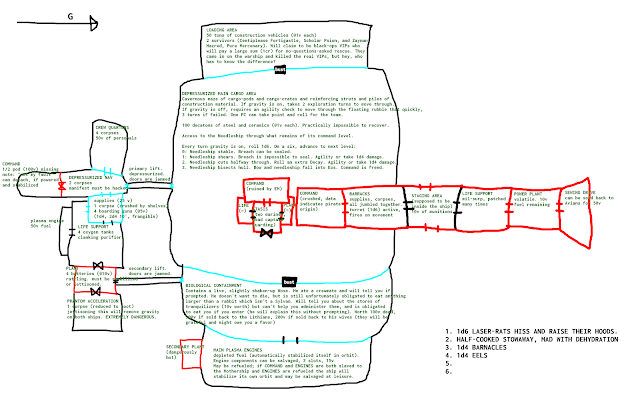
scale suggestive, not intended to be accurate.


    That, uh, "map" is for my own reference, and is only semi-readable to others. Let me give you some more information:

Approaching:

    "The LUCIDITY IS NOT A POSSIBILITY sits in low, decaying orbit, almost brushing the farthest-reaching fingers of the gas giant's clouds. The crew-area clings to the swollen cargo-area like a beetle on a ball of shit. Her tiny plasma engines are still online and struggling to keep the structure upright; the much larger primary engines, on the cargo-area, are dark and cold.
    "The second boat, the one responsible for this collision, looks like an Avian warship. Long, thin, designed for ramming cargo boats like this and disemboweling them. She sticks halfway out from the side of the cargo-area, bent like a hairpin. Looks like someone tried to jam a cigarette into an egg and gave up. Her engines are dead as well.
    "There's pretty significant damage to the hull of the cargo area, obviously. Looks like the whole thing warped and buckled from the forces of the impact. Pseudo-gravity is online, and the warship is visibly fighting to tear free by gutting the cargo-area completely. You might have a few hours before the superstructure collapses, or you might have thirty minutes."

    You don't need to point them out immediately, but a quick glance at the hauler makes it obvious to the PCs (all veteran spacemen) where points of interest like the conning tower, phantom-acceleration room and power plants are relative to each other.

Entering:

    "There are three plausible entrances to the cargo boat. The conning tower on the crew-area should have an airlock appropriate for your shuttle, and the lights are on so the systems should be functional. The massive loading doors on the bow of the cargo-area probably weigh as much as your shuttle, but there are wickets for easy access to the bay, which you should be able to hack or otherwise breach. Finally, there's a whopping great hole where the warship rammed the cargo-area. Shouldn't be a problem to hop from the shuttle into the Lucidity."

    It will, in fact, be a problem to hop from the shuttle into the Lucidity. The pseudo-gravity is leaking; a jump from the transport shuttle over to the hull might turn from a straight line to a ballistic arc just at the end, sending you "down" and, probably, towards the atmosphere of the gas-giant. Uhoh.

The Koss Transport:

    She's what the Avian warship collided with in the hull. Bad luck for the Avians; these transports were built in the second Battery War specifically to withstand collisions like that. Koss transports are 50m long and shaped something like a horseshoe crab. Their armor is the second-closest thing to indestructible in the System, and they have a dozen tiny pseudo-gravity systems built into their hulls for the sole purpose of bleeding off impulse (techno-babble for "their interiors don't have artificial gravity but also the crew doesn't splatter when the ship hits something").
    The transport can physically blat lighter, twinkier boats out of heaven. She can intercept fire from battleship main-guns without flinching, and run an arbitrarily-dense blockade with up to a dozen (skinny) (tightly-packed) VIPs and a single pilot. Koss transports are the armored limos of space: you wouldn't want to pay for the gas on a roadtrip, and you wouldn't want to have to crack one open with only a conventional warhead.

    This transport has four stasis pods, two of them smashed and their occupants killed, two of them on emergency power and their occupants badly injured. The transport's captain is lying prone behind a rifle on the loading ramp, in position to defend her ship and her crew with her life, if she hadn't bled to death in her ruptured suit a few hours ago. She died cold — bad luck. On her body is half of a contract stick. Combined with the other half, found in the Command room up in the crew-area, makes you the legal owner of one more combat mission for the two surviving Koss mercenaries. Worth a credit to the right buyer.

    The ship itself is a secondary objective if you can get it out of the cargo-area and to the Mothership for scrapping. The controls have been fried by EM, but you could try and jury-rig them to bash your way out of the hold, or just cut the hull out from beneath the transport.

Primary and Secondary Lifts:

    The elevator cars are smashed at the bottom of the shafts. If the pseudo-grav is still on, you'll have to climb with a grappling hook or magnet boots. The two shafts could be cut through fairly easily. If they're cut or collapse on their own (this happened to one group) then the cargo-area will start to rapidly fall into Eos and the crew-area will stabilize its own orbit, making for relatively easy salvage.

Navigation Room:

    The crewmen in this room died very, very hot — good luck. The hold was pressurized, so the warship's impact popped the hydraulic seals at the base of the primary lift, the door into the nav room, and the door into the crew quarters. The six corpses in these rooms show signs of primary blast injury; mottled faces, ruptured chest cavities, and crushed eyeballs. Go all in on the scene. "They're dead, but they don't even look surprised about it". Say things like "the walls are splashed with frozen blood" and "loops of icy intestines are splayed out like spaghetti".

Command Room:

    There's a handwritten note left on the big fancy captain's chair, reading

        Not my fault.
        Can't hail the rest of the crew.
        Falling into Eos.
        If you're looting my ship sometime in the next two hours, fuck you.


            Captain Valerio Adhara


    Of the two ultra-premium lifepods (mahogany paneling, leather seats), one is missing. The other can be jettisoned empty, or filled with bulky loot if you'd like. The shuttle can pick it up easily enough.
    An examination of the console reveals that the captain deleted his half of the contract with the Koss mercenaries, but forgot to empty his trashbin. It's easily recovered.

Phantom Acceleration Room:

    Here's how Lithians make artificial gravity: they start with a few discs-within-discs of ultradense material suspended on a cushion of magnetism, they spin 'em up to incredible speed, mrmflrbhurbabfm, linear momentum to angular momentum, linear moment to angular moment, mmmblafdhbiblf, gravity is not a force, murmblfhf, impulse, curved spacetime, bup bup bup.

    This is all well and good unless you're standing in the room with those spinning discs when your boat gets hit by something. The crewmember who was in here has been reduced to something like 13 kilos of carbon dust and 42 kilos of water vapor, assuming he started out at 70 kilos.

Loading Area NPCs:

    As soon as anything interesting happens on the boat, Zayman will try sending out from his hardsuit. The shuttle will hear him and notify the PCs by radio. If they're ever face-to-face, Centiplease, as a Psion, will contact the PCs telepathically and try to negotiate a deal to get him and his bodyguard off the ship and onto a neutral space station. It's not unreasonable for some Lithian company-men to want their comings and goings to be kept hush-hush, but Centiplease and Zayman will carelessly reference their warship instead of their cargo-hauler, will unconvincingly claim to be normal crewmen with no idea what happened, and have obviously been in a recent firefight.
    If pressed, Zayman will explain a "hypothetical" where "maybe" a group of "freedom fighters/terrorists" attempted to "intercept a Lithian black-ops squad" and were "unpleasantly surprised by the contents of the cargo-hauler" but were ultimately successful in killing the black-ops squad and "throwing their bodies" out of a convenient "airlock". Hypothetically. He can give the PCs dogtags if they think they need physical evidence of the fate of the two guests.
    If pressed further, or if the players start seriously discussing a plan to attack the two OOC, Zayman will use his Jump Jets to tackle the nearest PC and burn Simulspace rerolls kill the Hell out of them with his Vibro-Wakizashi. Be up front with the PCs about the risk; he's got Threat Projection, after all. Zayman will sell his life dearly to protect Centiplease, though the two of them are probably toast against more than one or two PCs. A sad end for a legendary pair of space-bandits.

    Centiplease's organization has enough money to make their rescue a secondary objective. Turning them in to the authorities for the bounty also counts. Faction play!


NPCs and Monsters


Laser-Rats
    Laser-rats are, technically, a kind of mustelid.
HD
: ½.
Lasers: 1d4 damage, 1d6 if they didn't fire last turn.

Stowaway
    Freezer-burned and somewhat crazy, wearing a bubble-helmet and not enough layers on his body. Miraculously survived the impact despite being exhausted, dehydrated, and space-crazy. Either desperate for rescue or murderously enraged, depending on the reaction roll.
HD: 1.
Wrench: hits for 1d4 damage.
Space-Crazed Babble: Every round you can hear his voice, make a Perception check. If you succeed, take 1 point of damage.

Barnacle
    As Cirripeds.

Eel
    As Anguillomorph.

Wose Young Juvenile
    The males of the Sylvan species are apex predators and obligate fratricides. They look like the reasonable halfway point between tigers and gorillas. They're brawny and ugly, with shredding-claws, crushing-jaws and camouflage stripes. Young juveniles are about the size of a shuttle.
HD: 20
Armor: 2
Obligate Fratricide: Must attack organic creatures which are larger than a rabbit AND not a Sylvan. Cannot fail morale checks if doing so would prevent him from attacking a valid target.
Apex: On his turn, makes one bite attack and two claw attacks
Bite: 1d6 damage, healing for the same amount if used on a biological enemy.
Claw: 1d8 damage, ignoring 1 point of armor.

Koss Mercenary
    Wearing combat-rated Hardsuits in their company's liverie, and armed to their many needle-like teeth. Koss women are about 12' at eye-level and feel no moral pangs when stomping on childlike enemies.
HD: 3
Armor: 1
Monstrous Size: PCs fail strength checks by default. Has 20 strength, if it matters.
Power Armor: Wearing the equivalent of a Hardsuit equipped with Coolant Tanks, Ablative Armor and a Tower Shield. Equipped with a Monstrous Handgun and a random weapon from their list.
Monstrous Handgun: 60' range, 1d6 damage.
K76 Sip-Northover Incendiary Problems Projector: a rapid-fire incendiary limpet launcher, designed for area-denial and ambuscades. 1d6 damage in 10' radius, pierces Thin walls when set off. Rounds stick to metal and can be detonated later. 100' range. Targets caught in the blast are set on fire, taking 1d4 damage a round until they take an action putting themselves out. Can be fired twice in a combat turn generating the Heat of two attacks.
K205 Cryptogenic Ski-Troop Enabler: a backblast cryo-fluid launcher, designed to give the user high-speed movement over level ground and small enemies. 1d8 damage in a 60' line, piercing no walls, generating no Heat. When firing the weapon everything within a semicircle behind you is tossed 30' away. If you lack 30' of rear clearance, you are tossed forward.
LSW-500 Woman-Portable Beam (Variable Lens): an internal-spooling incendiary beam emitter. 1d6 damage at 100', 1d8 if you didn't attack last turn, piercing no walls. Sets targets on fire. Internal mechanisms can change the beam type (the Ammo), given 1 Heat and an exploration turn.
[unnamed, poorly advised hunter-killer drone project]: a light flak drone hive. Deals 1d4 damage to anyone within 60' (goes around corners), piercing no walls. Max damage to flying enemies and objects.
K202 BLASH: a bombardment explosive rocket pod, for safely obliterating your enemies in a mixed-cover mixed-allegiance and target-rich environment. 2d4 damage in a 20' radius at 200', piercing Thick walls. Damage is divvied out to targets in the blast radius as you please. Can deal maximum damage in one attack, though its ammunition is expended for the rest of the mission

Centiplease Fortigaster
    An Avian scholar. The smallest caste, both physically and in raw numbers, but the top of the heap regardless. Their feathered wings are five meters from tip to tip. Their bones are too heavy for true flight, but they can hurt you terrible by flapping.
    HD: 3 (1/11 HP when you encounter him)
    Psion A–B: knows Lesser Telekinesis, Send/Receive and Remote Viewing.
    Scholarly Swordsman: may make two attacks per turn with his bitching space katanas
    Bitching Space Katanas: 1d6 damage, ignoring a point of armor.

Zayman Hazred
    A Pure. Grizzled, dangerous, wearing a hardsuit he's been tinkering with for 20 years. Probably rather gruff unless there's another old coot in a hardsuit or another mercenary with a simulspace addiction.
    HD: 3 (6/11 HP when you encounter him)
    Armor: 1
    Powered Armor: Wearing the equivalent of a Hardsuit equipped with Jump Jets, Passive Radiators and Ablative Armor.
    Mercenary A–B: knows Microgravity Agility 1, Threat Projection 1, Simulspace Addict 2
    Double-Barreled Varmint Gun: a rapid-fire frangible scattergun, for killing space-vermin without puncturing walls. 1d8 damage in a 30', rerolls 1s and 2s on damage rolls against unarmored targets, pierces no walls.
    Vibro-Wakizashi: a snub-nosed armor-piercing melee weapon, for killing the Hell out of combat robots and people in power armor. Deals 1d12 damage at grappling range, ignoring armor, passing through Thick walls.


Weapon Generation.


    Archon has two or three different systems now, but this is the way I do it. Roll 3d12 for Weapon, Ammo and Augmentation.

Weapon
1. Rifle- 1d6 damage, pierces Thin walls, 100' range.
2. Beam Emitter - 1d6 damage, doesn't pierce, charges to 1d8 if you didn't use it last round, 100' range.
3. Rocket Pod - 2d4 damage, split the damage between as many targets as you want, pierce Thin walls, 200' range.
4. Scattergun - 1d8 damage in a 30' cone, pierces Thin walls.
5. Melee - 1d10 damage in melee, pierces Thin walls.
6. Drone hive - 1d6 damage, can fly around corners, doesn't pierce, 60' range.
7. Autocannon - 1d8 damage, 20' radius, pierces Thick walls, 100' range.
8. Limpet Launcher - 1d6 damage, 10' radius, pierces Thin walls when set off, rounds stick to metal and can be detonated later, 100' range.
9. Fluid Thrower - 1d8 damage in a 60' line. doesn't pierce walls, generates no Heat.
10. Claymore Array - 1d6 damage to everyone within 100', destroys Thin walls.
11. Disc Launcher - 1d6 damage at 100', ricochets to a random target for 1d4 damage. Doesn't pierce walls.
12. Assault Cannon - 2d6 damage, +1 Heat per combat, pierces Thick walls, 100' range.

Ammo
1. Armor-piercing - ignores armor, wall pierce up step.
2. Frangible- no longer pierces walls. Reroll 1s and 2s on damage rolls against unarmored targets.
3. Flak - no longer pierces walls. Deals maximum damage to drones and other fast-moving targets.
4. Explosive - damage radius is increased by 20', wall pierce up one step.
5. Recursive - adds Heat to damage rolls.
6. Incendiary - targets take 1d4 damage each round until the fire is put out.
7. Cryo - targets must Save or cannot move on their next turn.
8. Pulse - targets must Save or be knocked down when hit.
9. Rail-assisted - range up one step.
10. Beacon - all your subsequent attacks against target have +1 damage. stacks.
11. Spalling - ignores armor, deals extra damage equal to target's armor.
12. Wildcat - damage die up one step, gain 1 Heat if damage is above normal maximum.

Augmentation
1. Light - damage die and wall-piercing down one step, reduce Heat cost to fire by 1.
2. Heavy - damage die and wall-piercing down one step, increase Heat cost to fire by 1.
3. Autonomous - fires under the control of a computer. You can use this weapon and take another action.
4. Rapid-fire - you may attack twice, each attack costing normal Heat.
5. Hardpoint-mounted - damage, wall piercing and range up one step, increase Heat cost to fire by one. You cannot move and fire this weapon on the same turn.
6. Assisted Targeting - spend an action and choose a target. Damage against that target is rolled with advantage. Targeting does not cost Heat.
7. Bombardment - you can choose to have the weapon deal its maximum damage on its attack, but it runs out of ammunition or charge and cannot be used again during this expedition.
8. Heatsink - the first shot during each combat generates 1 less Heat.
9. Internal Spool - may change Ammo type. This takes 1 Exploration Turn, and generates 1 Heat.
10. Backblast - When firing the weapon, everything within a semicircle behind you is tossed 30' away. If you lack 30' of rear clearance, you are tossed forward.
11. Snub Barrel - range down one step. Damage up one step.
12. Badly Malfunctioning - deals 1 damage to you when it would generate Heat. Damage die up one step.


Damage steps: 1, 1d4, 1d6, 1d8, 1d10, 1d12, 1d20
Range steps: grapple, melee, 30', 60', 100', 200', 500'
Wall-piercing steps: none, Thin, Thick, Armored, any number of walls until it hits Armored, any number of walls